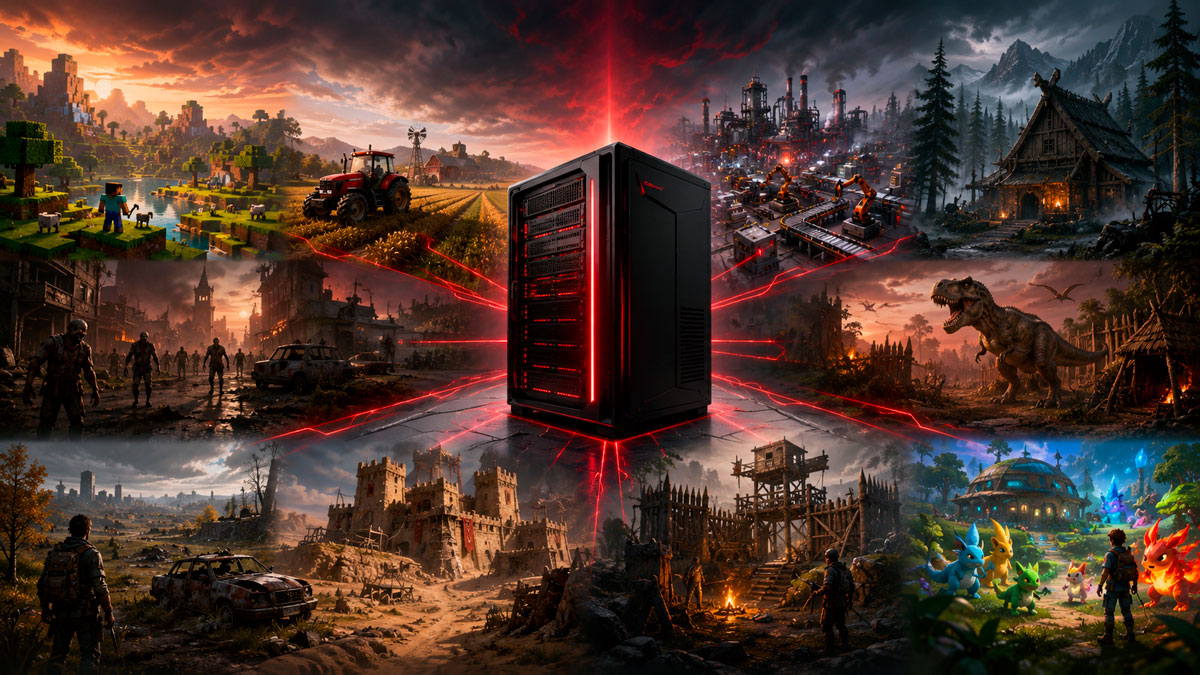
Dedicated Game Server: 10 Best Games to Host in 2026
Some multiplayer games work perfectly well when one player simply hosts a session for a few friends. Others become significantly better once the world is moved to a dedicated game server: always available, independent from a player's PC and easier to manage over the long term.
Persistent survival games, sandbox worlds, cooperative building games and heavily modded communities are particularly good candidates. A dedicated server allows players to connect without waiting for the original host, centralizes saves and configuration, and provides a stable environment that can remain online day and night.
But not every game has the same requirements. A private Valheim world for five friends is very different from a large Rust community or an ARK cluster running several maps. This guide compares 10 games that benefit particularly well from dedicated hosting, with recommended group sizes, administration difficulty and the main advantages of running each game on its own server.
Which Games Benefit Most from a Dedicated Server?
The following player counts are recommended group sizes, not technical slot limits. They indicate the type of community for which dedicated hosting becomes particularly useful. Some games can host significantly more players depending on configuration and hardware.
The difficulty rating also refers to manual server administration. Using a hosting platform with automated installation considerably reduces the work required to deploy and update the server.
| Game | Recommended group | Dedicated server value | Administration | Resource profile |
|---|---|---|---|---|
| Minecraft | 4–30+ | Excellent | Easy → Advanced | Low → High |
| Farming Simulator 25 | 4–16 | Excellent | Easy | Moderate |
| Satisfactory | 2–8 | Very high | Easy → Moderate | Moderate |
| Valheim | 3–10 | Excellent | Easy | Low → Moderate |
| Project Zomboid | 4–20+ | Excellent | Moderate | Moderate |
| ARK: Survival Ascended | 5–30+ | Excellent | Advanced | High |
| Rust | 10–100+ | Essential for communities | Moderate → Advanced | High |
| DayZ | 10–60+ | Excellent | Advanced | Moderate → High |
| Conan Exiles | 5–40+ | Excellent | Moderate | High |
| Palworld | 4–20+ | Excellent | Moderate | Moderate → High |
1. Minecraft — The Ultimate Dedicated Server Sandbox
Recommended group: 4–30+ players
Administration: Easy for vanilla, potentially advanced for large modded servers
Best for: Friends, families, modpacks, public communities and custom game modes
Minecraft remains one of the clearest examples of a game that scales naturally from a tiny private world to a complete online community. A locally hosted world may be sufficient when everybody plays together, but a dedicated server removes the dependency on a single player's computer.
The main advantage is flexibility. Administrators can keep things simple with vanilla Minecraft or build much more complex environments using server implementations, plugins and mod loaders. The server can become a survival world, a creative construction space, a minigame platform or a heavily modified experience with hundreds of additional features.
- World available independently from the original host.
- Excellent plugin and modding ecosystem.
- Whitelist, permissions and administrator tools.
- Easy to start but capable of scaling into extremely complex servers.
- Resource requirements can be adapted to the size and complexity of the world.
2. Farming Simulator 25 — A Shared Farm That Is Always Available
Recommended group: 4–16 players
Administration: Easy
Best for: Cooperative farms, communities and multiplayer groups with different schedules
A Farming Simulator 25 server solves one of the most common problems in long-term cooperative games: the farm no longer belongs to the computer of one specific player.
Players can access the same persistent farm without asking the person who created the save to launch the game first. That makes dedicated hosting particularly useful for communities where different players manage fields, animals, forestry or logistics at different times of day.
Mods are another major reason to centralize the game. Instead of treating one person's installation as the reference, the server becomes the shared environment around which the multiplayer session is organized.
- A persistent multiplayer farm available without the original host.
- Ideal for players connecting at different times.
- Centralized savegame and mod management.
- Particularly useful for roleplay and organized farming communities.
- Relatively accessible administration compared with many survival games.
3. Satisfactory — Turn a Factory into a Long-Term Team Project
Recommended group: 2–8 players
Administration: Easy to moderate
Best for: Small cooperative groups and long-running factories
Unlike games where a dedicated server mainly becomes useful when dozens of players are involved, Satisfactory can justify one with only a handful of people.
A large Satisfactory factory quickly becomes a collaborative project. One player may optimize power generation while another rebuilds transport infrastructure or develops a new production line. Hosting the save independently means every member of the group can join the shared world without relying on the person who originally created it.
Server requirements also tend to increase as factories become larger and simulation complexity grows. For long-term worlds, leaving some performance headroom is more sensible than sizing a server only for the first few hours of gameplay.
- Shared factory independent from one player's game client.
- Excellent for asynchronous cooperative building.
- Centralized save management.
- Server resources can scale with increasingly complex factories.
4. Valheim — One of the Best Choices for a Small Group
Recommended group: 3–10 players
Administration: Easy
Best for: Friends looking for a persistent cooperative survival world
Valheim may be one of the strongest examples of why player count alone should not determine whether dedicated hosting is useful. The game is designed around relatively small groups, but its exploration, construction and progression systems make a persistent shared world extremely convenient.
Players can explore independently, work on the settlement or gather resources without requiring the owner of the world to launch the game first. Administration is also relatively straightforward compared with more complex survival servers.
5. Project Zomboid — Persistence and Server Rules Change Everything
Recommended group: 4–20+ players
Administration: Moderate
Best for: Persistent survival worlds, modded servers, PvE, PvP and roleplay
In Project Zomboid, the server is not simply a place where players meet. Its configuration defines much of the survival experience.
Administrators can shape loot availability, zombie populations, progression, safehouses, PvP rules and many other aspects of the world. Combined with the game's extensive modding scene, that makes Project Zomboid particularly attractive for communities that want to build their own interpretation of the apocalypse.
The downside is that every additional mod and custom rule adds another element that must be maintained. Backups and controlled updates therefore become increasingly important as the server grows.
- Highly configurable persistent world.
- Strong mod support.
- Suitable for private groups and larger communities.
- Extensive PvE, PvP and roleplay possibilities.
- Good backup discipline becomes increasingly important on long-running worlds.
6. ARK: Survival Ascended — When Server Resources Really Matter
Recommended group: 5–30+ players
Administration: Advanced
Best for: Persistent tribes, modded worlds and multi-map communities
Few survival games demonstrate the value of proper server sizing as clearly as ARK: Survival Ascended.
Bases, tamed creatures, inventories, world simulation and mods create a persistent environment that can become increasingly demanding as a community expands. Administrators can also modify harvesting rates, taming speeds, experience progression, breeding and many other gameplay systems.
Running several maps makes the equation even more important. A cluster is effectively managing multiple server instances, so CPU, memory and storage requirements must be considered globally rather than map by map.
7. Rust — A Game Built Around Servers and Communities
Recommended group: 10–100+ players
Administration: Moderate to advanced
Best for: PvP communities, custom servers and long-term server projects
For Rust, servers are not an optional side feature: they are central to the game's identity. Players choose communities according to map size, population, wipe schedule, rules, progression and the level of modification.
Running a successful Rust server therefore involves more than simply keeping the executable online. Administrators must think about maps, wipes, moderation, performance, backups, plugins and community rules.
Population can also vary dramatically. A private server for a group of friends has little in common with a public server receiving dozens or hundreds of simultaneous players. Choosing infrastructure with room to grow becomes increasingly important once the project is intended to attract a public community.
- Persistent competitive environment.
- Extensive server customization.
- Community and plugin ecosystems.
- Wipe management is part of server administration.
- Performance requirements rise substantially with population and world activity.
8. DayZ — Build Your Own Version of the Apocalypse
Recommended group: 10–60+ players
Administration: Advanced
Best for: Community servers, survival variations, PvE, PvP and heavily customized experiences
A DayZ server can be much more than a private copy of the official experience. Community administrators can create very different environments through server configuration, economy changes, mods, custom events and gameplay rules.
One server may focus on hardcore survival with scarce loot, while another emphasizes PvE, roleplay, traders or intense PvP. This flexibility is one of DayZ's greatest strengths, but it also explains why administration can become considerably more technical than on simpler cooperative games.
For serious communities, the dedicated server becomes the foundation on which the entire experience is built. Configuration, mod compatibility, updates and performance monitoring matter just as much as raw player capacity.
9. Conan Exiles — An Excellent Platform for PvE, PvP and Roleplay
Recommended group: 5–40+ players
Administration: Moderate
Best for: Clans, PvE groups, PvP communities and roleplay servers
Conan Exiles gives private server administrators considerable freedom over the way their world operates. Progression rates, gathering, crafting and PvP rules can all contribute to a very different experience from one community to another.
That flexibility makes dedicated hosting particularly appealing for roleplay and organized communities. The same game can support a relaxed cooperative world, a competitive clan environment or a heavily modified roleplay server.
Large bases, active players and mods can increase server requirements over time, so long-term communities should once again avoid choosing hardware solely around their launch population.
10. Palworld — Dedicated Hosting Makes Cooperative Progression Easier
Recommended group: 4–20+ players
Administration: Moderate
Best for: Cooperative groups, guilds and persistent community worlds
Since reaching version 1.0 in 2026, Palworld remains an excellent candidate for persistent multiplayer hosting. Pocketpair provides dedicated server software specifically so that the shared world does not need to be hosted continuously from a player's game client.
That is particularly useful once a group begins building several bases and treating the server as a long-term shared world. Administrators can configure numerous gameplay parameters and also use compatible server mods, although mod compatibility and platform requirements should always be checked before deployment.
Palworld can also be relatively memory-hungry compared with lightweight cooperative games. As a world expands and the community grows, additional server resources provide useful headroom.
- Shared world independent from the host's gaming PC.
- Persistent bases and cooperative progression.
- Extensive gameplay configuration.
- Dedicated server software for Windows and Linux.
- Resource requirements should account for long-term world growth.
How Much RAM Does a Game Server Need?
There is no reliable universal rule such as “Minecraft needs 4 GB” or “ARK needs 16 GB”. Those numbers can be useful starting points, but they quickly become misleading because RAM is only one part of server performance.
The real requirement depends primarily on:
- Concurrent players: more active players generally create more work for the server.
- World complexity: large bases, explored regions, entities and automation systems can increase load.
- Mods and plugins: heavily modified servers can require substantially more resources than vanilla installations.
- CPU performance: some games are particularly sensitive to processor speed and cannot compensate for a slow CPU simply by adding more RAM.
- Number of server instances: hosting several maps or games means their combined requirements must fit within the machine.
A good server configuration should therefore be based on the workload you actually intend to run, with some headroom for future growth.
Game Server Hosting or a Multi-Game Dedicated Solution?
The right hosting model depends on what you actually want to run.
One Game, One Community
If your only goal is to run a single Minecraft, Valheim or FS25 world, a straightforward game server configuration is usually enough.
Several Games or Servers
If your community regularly switches games or needs several instances, allocating CPU, RAM and storage across a multi-game platform becomes more flexible.
A PC Left Running at Home
Self-hosting can be perfectly adequate for testing or occasional sessions, but it requires the machine, internet connection and administrator to remain available.
VeryGames' DediGames® Box follows the multi-game approach: CPU, memory and storage are allocated to a box from which several supported game servers can be deployed and managed. This is particularly useful for communities that move between several games rather than renting an independent product each time.
Which Game Should You Choose for Your First Dedicated Server?
| Your goal | Good choices |
|---|---|
| Play with 3–5 friends | Valheim, Satisfactory, Minecraft |
| Build a heavily modded world | Minecraft, Project Zomboid, DayZ |
| Create a public survival community | Rust, ARK, Conan Exiles, DayZ |
| Relaxed cooperative progression | Farming Simulator 25, Valheim, Palworld |
| Host several different games | Multi-game hosting such as DediGames® Box |
Frequently Asked Questions
Do you need to leave your PC on when using a dedicated game server?
No. The server runs independently from your gaming PC, so players can connect even when the person who created the world is offline.
Does a dedicated server reduce ping?
Not automatically. Latency depends largely on network routing and physical distance between players and the server. A well-connected datacenter in an appropriate region can provide more consistent network conditions than a residential connection, but no hosting solution can eliminate geographical latency.
Can you install mods on a dedicated server?
Usually, but support depends on the game. Minecraft, Project Zomboid, ARK, DayZ, Conan Exiles and many other titles have extensive modding ecosystems. Always check compatibility between the server version, mods and connected clients before updating a long-running world.
Can several games run on the same server?
Yes, provided that the hosting platform supports multiple instances and the available CPU, memory and storage are sufficient for their combined workload.
When does renting a dedicated server become worthwhile?
Usually when the world needs to remain accessible without its original host, when several players connect at different times, when mods and administration become important, or when a community needs more predictable availability than a home PC can provide.
The Best Dedicated Server Game Depends on Your Community
There is no single best game for dedicated hosting. Valheim and Satisfactory show that even a small group can benefit enormously from a persistent server, while Rust, DayZ and ARK demonstrate how hosting becomes the foundation of an entire community.
The important question is therefore not simply how many players you have today. Think about how often they play, whether they need independent access, how heavily the game will be modified and how much the world may grow over time. Choosing a server around those real requirements will usually produce a better experience than relying on a fixed RAM number or theoretical slot count.
Host your games with DediGames® Box
Deploy and manage multiple supported game servers from one platform, with resources that can be adapted to the needs of your community.