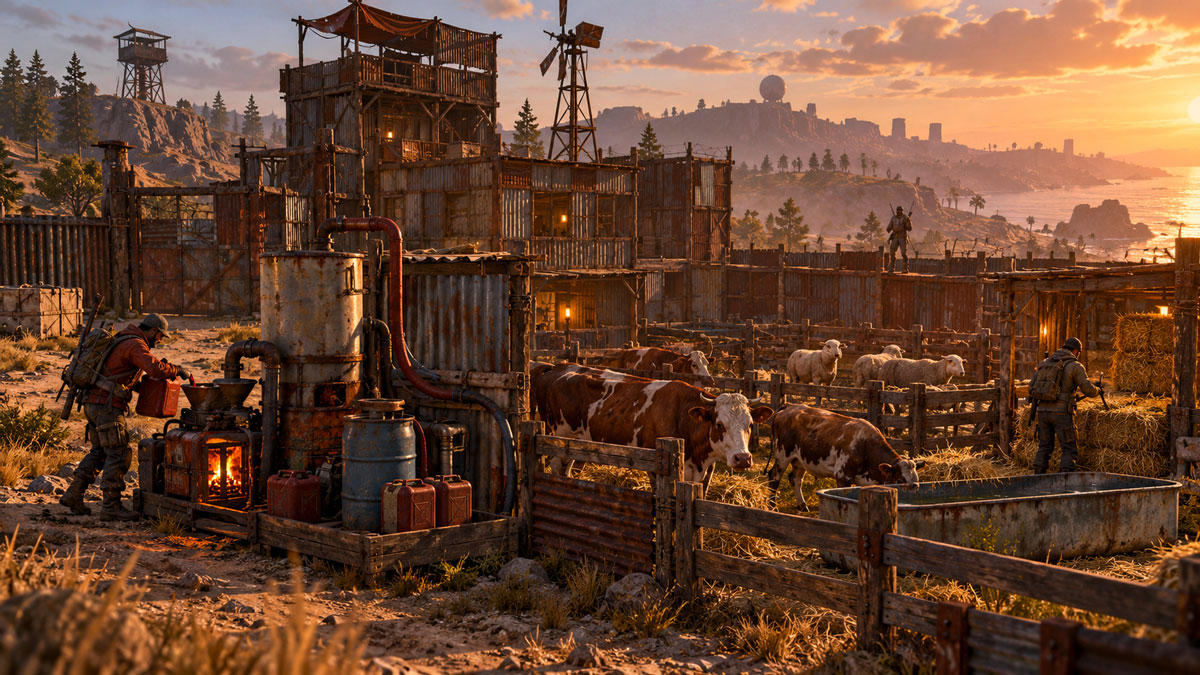
Rust turns survival into farming with livestock, biofuel and a fresh map wipe
Rust's October 2026 update is preparing to give farming a much bigger role in the survival sandbox. Cows, sheep, animal breeding and a new Biofuel Generator are at the centre of the changes currently moving through Facepunch's public development branches.
The update coincides with Rust's monthly forced wipe on Thursday, October 1, 2026. For players, that means another race for territory and resources. For server owners, it means preparing a fresh world save and making sure the server is ready for the new game build.
What to remember: Facepunch's 2026 roadmap officially lists new animal types, animal breeding and the Biofuel Generator for Q4. Public development work also shows cows, sheep, wool, milk, dung production and livestock-related systems being integrated ahead of the October wipe. The final patch notes may still change individual mechanics or balance values.
Cows and sheep turn farming into a real progression system
Rust already includes crops, horses, chickens and several food-production mechanics, but the new livestock system goes further by making animals something players can actively maintain as part of their base economy.
Facepunch's public development work includes cows, bulls, calves, sheep and lambs, with systems built around feeding, animal behaviour, reproduction and resource production.
Breeding is particularly important. Instead of livestock simply acting as another source of meat, players should be able to maintain herds over time and turn a protected section of their compound into a productive farm.
Development commits also show genetic characteristics affecting livestock and even influencing the value of animals when sold. That could make carefully maintained animals significantly more interesting than simply hunting whatever happens to spawn nearby.
- cows, bulls and calves;
- sheep and lambs;
- animal breeding and herd behaviour;
- feeding and livestock condition;
- wool production and sheep shearing;
- milk and other animal resources;
- dung production;
- livestock trading and transport systems.
For larger groups, this potentially creates a completely new type of compound. A base may no longer contain only furnaces, storage, electrical systems and crop farms: protected livestock areas could become another valuable part of long-term progression.
The Biofuel Generator gives food and farming another purpose
The other major addition is the Biofuel Generator, which Facepunch also lists on its official 2026 roadmap.
Public development commits show the machine converting food into Low Grade Fuel. The amount produced and the processing time are being tied to the caloric value of the food used, while the mixture also requires periodic interaction from the player during production.
This is particularly interesting when combined with livestock. Animal farming produces food and dung, while the Biofuel Generator creates another way to transform agricultural resources into something useful to almost every active Rust group.
Low Grade Fuel remains essential for several important parts of Rust's economy and transportation. Creating another renewable production route could therefore make established farms more strategically useful during longer wipes.
A new resource loop is emerging:
feed animals → maintain livestock → collect agricultural resources → process surplus resources → produce fuel.
The exact conversion rates and balance should still be considered provisional until Facepunch publishes the final October patch notes.
Rust's wildlife is getting busier too
Facepunch is not only working on farm animals. Public development branches have also included smaller wildlife such as rabbits, squirrels, frogs, crabs and sea turtles.
These creatures are being developed with their own behaviour and activity patterns rather than functioning purely as decorative objects. Work has also been carried out to keep the additional AI workload under control when no players are nearby.
The result should be a Rust island that feels more alive, while livestock adds wildlife that players actively interact with instead of simply hunting.
Not every experimental animal or behaviour visible in the development branches is guaranteed to be part of the final October build, however, so the complete launch list will depend on the final Facepunch changelog.
Barricades and base tools are also being refined
Alongside livestock, Facepunch has recently been working on Rust's sandbag barricades. Changes visible in the main development branch include improved collision meshes, larger stack sizes and adjustments to how barricades are distributed as loot.
Additional sandbag variants have also been tested during development, including lower-height versions and a pillbox-style barricade.
These may appear less important than livestock, but deployable cover can have a real effect on early-wipe fights, temporary positions and the way groups defend areas before a full compound is established.
October 1 also means a forced Rust map wipe
The October update lands on the first Thursday of the month, which is Rust's normal monthly forced-wipe window.
Under Rust's default server wipe schedule, monthly servers reset on the first Thursday of every month at 19:00 London time. On October 1, that corresponds to approximately 20:00 CEST.
A forced wipe should not be confused with an automatic global blueprint wipe.
Facepunch's server documentation explains that forced protocol changes generally invalidate the existing world save, while blueprint data is stored separately.
We covered this distinction in more detail in our previous guide explaining how Rust forced wipes work and what they actually delete .
What server owners should prepare before the update
For community and modded server administrators, October 1 is therefore more than a normal restart.
- Back up the current server configuration before the update.
- Prepare the new map seed or custom map you want to use for the next wipe.
- Check whether your own wipe policy also includes player blueprints.
- Verify plugin and framework compatibility after the new server build becomes available.
- Inform your community of the planned restart and fresh-map schedule.
Modded servers should pay particular attention to plugins that interact with animals, farming, loot, metabolism or deployable entities. A major gameplay system can sometimes require plugin developers to publish compatibility updates after the Rust server build changes.
A very different start to the next Rust wipe
The Livestock update has the potential to change more than Rust's scenery. Animal breeding, wool, milk, dung and biofuel all give players new reasons to dedicate space and resources to farming.
That may create an interesting choice during the October wipe. Do you spend the first hours securing weapons, monuments and raid materials as usual, or start building the infrastructure required for a profitable livestock operation?
For established communities, farming could become another part of the server economy rather than a secondary survival mechanic.
Start the new Rust wipe on your own server
VeryGames lets you deploy and manage your own Rust server from the DediGames® Box control panel, with automatic access to the latest Rust server versions, backups, scheduled tasks and support for popular plugins.
Launch your Rust server